








A New Era in Health Research
Established within Atlas University, the Atlas Research Center (ARC) aims to increase scientific output by effectively utilizing its advanced research infrastructure, to develop an interdisciplinary research culture, and to strengthen international collaborations.
The center, which brings together research groups working in the fields of neuroscience, biotechnology, tumor biology and cloning, cardiovascular and metabolic research under one roof, will contribute to the development of innovative research in health sciences.
Dr. Yusuf Elgörmüş: “ARC is a Strong Investment in the Future”
Speaking at the opening ceremony, Dr. Yusuf Elgörmüş, Chairman of the Board of Trustees of Atlas University, drew attention to the importance of scientific research in the development of societies and said the following:
“The Atlas Research Center is a significant indicator of our university's research and innovation vision. We aim to create a strong ecosystem that supports the production of scientific knowledge and enables internationally recognized research. We believe that the work to be carried out at ARC will contribute both to the scientific community and to human health.”
"Brain Power, Not Brain Drain"
Dr. Yusuf Elgörmüş noted that they have strengthened their collaborations with universities worldwide with their internationalization vision, stating, “We are working intensively to establish joint studies and collaborations with all academics who conduct their research abroad and wish to contribute to this country, science, and humanity. Atlas University has this mission and vision. We want to include all elements that will contribute not only to science but to all of humanity. The Turkish academy has a very deep presence abroad. It is no longer necessary to view the departure of our successful scientists abroad solely as 'brain drain.' Today, it is possible to see this as a 'brain power' as well. Today, communication and collaboration are easier than ever thanks to the opportunities provided by the digital world. By strengthening the ties we have established with our scientists working abroad, we can turn this situation into a significant opportunity for our country. We aim to increase these examples and collaborations.”
"Strong Cooperation with Turkish Academics Abroad is Aimed"
Dr. Yusuf Elgörmüş stated that Turkish academics who have achieved significant success abroad, particularly in the US and Europe, are building a major bridge, and added, “We will strengthen our relations with these academics. We have two major tasks: firstly, we will create contributions for our country, and secondly, we will bring the experience of Turkish academia, which has achieved great success abroad, here.”
Prof. Dr. Ersoy Kocabıçak: “This will further strengthen our scientific production capacity.”
Atlas University Rector Prof. Dr. Ersoy Kocabıçak stated that the center will play an important role in the university's research-oriented development and said the following:
“Universities are not only institutions that provide education, but also structures that produce knowledge and add value to society. With the Atlas Research Center, we are offering our researchers stronger opportunities while creating a research environment where different disciplines can develop joint projects. This center will further advance the scientific production capacity of our university.”
Personalized Medicine and Artificial Intelligence-Focused Research
Atlas Research Center (ARC), ARC is a new generation research center established to strengthen Atlas University's scientific research capacity, effectively utilize its advanced research infrastructure, and support interdisciplinary projects. ARC, representing Atlas University's strong investment in science, innovative research, interdisciplinary collaboration, and future health technologies, stands out not only for its physical infrastructure but also for its underlying vision, international scientific support, research groups, translational approach, AI-supported research capacity, and open collaboration model.
ARC's founding visionUnder the leadership of the Chairman of the Board of Trustees, Dr. Yusuf Elgörmüş, and the Rector, Prof. Dr. Ersoy Kocabıçak, the goal is to advance scientific production in Türkiye, conduct research at international standards, and create a strong research ecosystem capable of developing innovative solutions in the field of health.
The vision of internationalization made a significant contribution.
The university's internationalization vision also played a significant role in the center's structuring process. The expertise and scientific support of internationally experienced scientists such as Prof. Dr. Yasin Temel from the Department of Neurosurgery at Maastricht University Medical Center (MUMC+) and Prof. Dr. Süleyman Ergün, Director of the Institute of Anatomy and Cell Biology at Julius Maximilian University of Würzburg, were utilized.
An Interdisciplinary Research Platform: ARC
ARC was designed as an interdisciplinary research platform bringing together research groups working in the fields of neuroscience, biotechnology, tumor biology and cloning, cardiovascular and metabolic research.
Diseases will be examined using a holistic approach.
The center's fundamental approach is to examine human diseases holistically, not from a single perspective, but by combining molecular, cellular, clinical, and data-driven analytical approaches. Today, health research is increasingly moving towards personalized medicine; understanding disease mechanisms at the individual level, developing personalized diagnostic strategies, and evaluating treatment responses on a patient-by-patient basis are becoming increasingly important.
A personalized diagnostic and treatment approach will be adopted.
One of ARC's main goals is to develop research models that can contribute to personalized diagnostic and treatment approaches.
Human-based models will be developed.
Within this scope, the center aims to develop human-based models, such as organoid and assembloid systems, using cells obtained from patient samples. These models will allow for more realistic examination of disease mechanisms in a laboratory setting, research into how different drugs respond to patients, and the evaluation of personalized treatment options. Furthermore, developing three-dimensional research models that better represent human tissues using bioprinting technologies is among the center's primary goals.
A multidisciplinary research ecosystem will be established.
ARC aims to advance experimental research alongside artificial intelligence and data science-based approaches. The evaluation of genomic, molecular, cellular, and clinical data obtained from laboratory studies, combined with machine learning, bioinformatics, and multi-omics data integration methods, will contribute to a more comprehensive understanding of disease mechanisms and the development of personalized research outcomes.
This approach requires the collaboration of engineering, data science, basic sciences, and clinical research. Therefore, ARC is conceived not merely as a laboratory space, but as a multidisciplinary research ecosystem where different disciplines can collaborate on projects.
Throughout scientific history, animal models have made extremely important contributions to the development of modern medicine and form the basis of many treatment approaches achieved today. However, the need to reduce unnecessary animal use and develop models that more accurately represent human biology is gaining increasing importance in the scientific world. To study the complex nature of human diseases more realistically, new generation human-based research approaches such as organoid systems, organ-on-chip platforms, assembloid structures, bioprinting technologies, and advanced cellular models are rapidly developing. ARC's goal is to create a research ecosystem that is ethically sensitive, closely follows current scientific developments, and supports future translational research models.
Atlas University having its own hospital is a significant advantage for ARC. Thanks to the strong link established between clinical fields and basic sciences, there is significant translational research potential in terms of access to patient samples, transforming clinical observations into research questions, analyzing laboratory findings with data science and artificial intelligence approaches, and transferring the results to healthcare applications.
A center open to researchers and collaborations.
ARC's goal is not only to serve researchers within Atlas University. The center is designed to be open to external stakeholders, researchers from different institutions, and creative scientific ideas through applications for research and laboratory use, project collaborations, and internships. Thus, ARC aims to be more than just a research infrastructure; it seeks to be a productive science and innovation ecosystem bringing together scientists, engineers, clinicians, data scientists, and researchers from diverse disciplines.
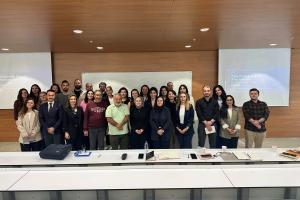
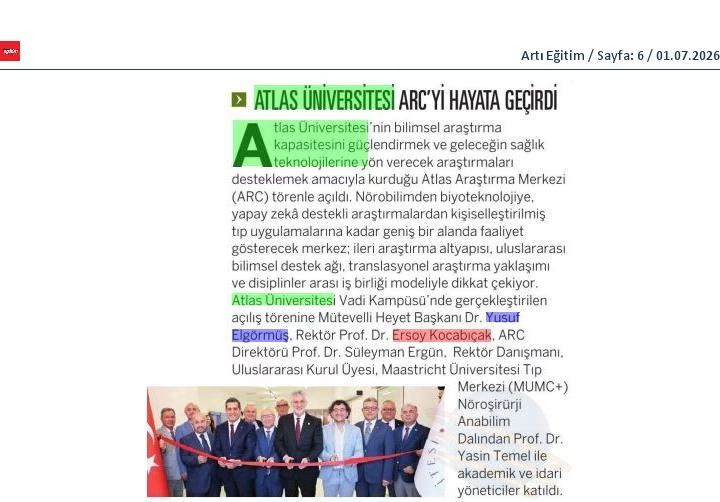
The opening ceremony, held at Atlas University's Valley Campus, was attended by the Chairman of the Board of Trustees Dr. Yusuf Elgörmüş, Rector Prof. Dr. Ersoy Kocabıçak, ARC Director Prof. Dr. Süleyman Ergün, Rector's Advisor, International Board Member, and Head of Neurosurgery Department at Maastricht University Medical Center (MUMC+) Prof. Dr. Yasin Temel, as well as academic and administrative staff. The program included a presentation of the center's research vision and areas of work, and a visit to the laboratories.