










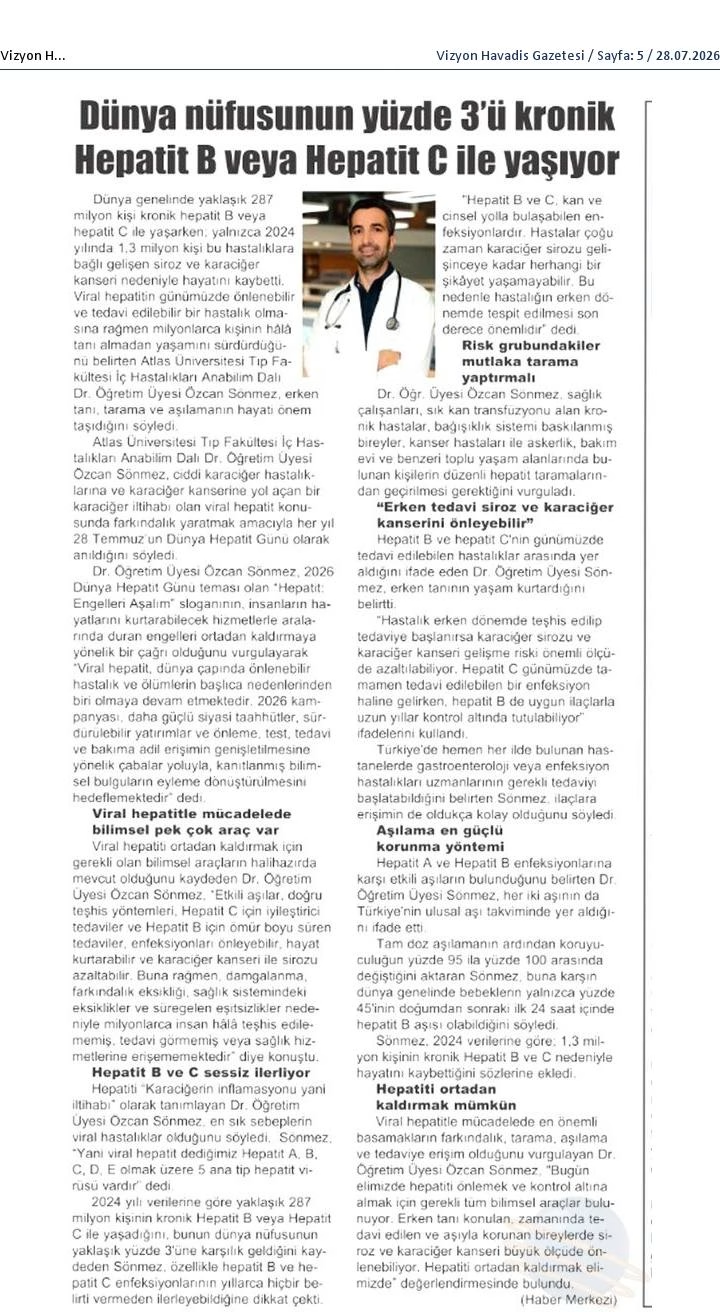
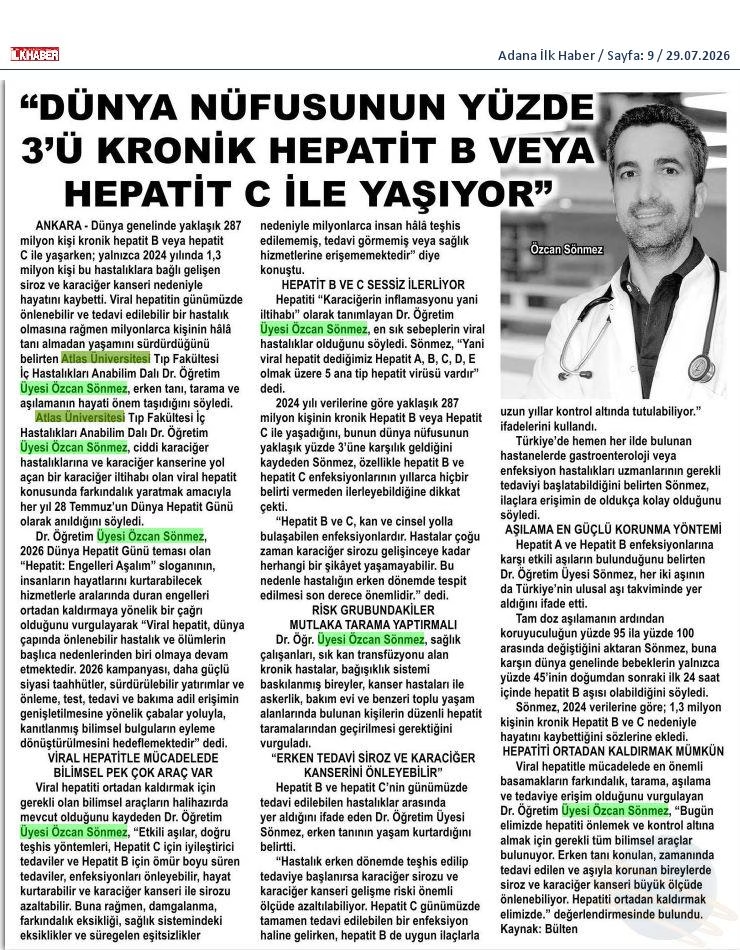
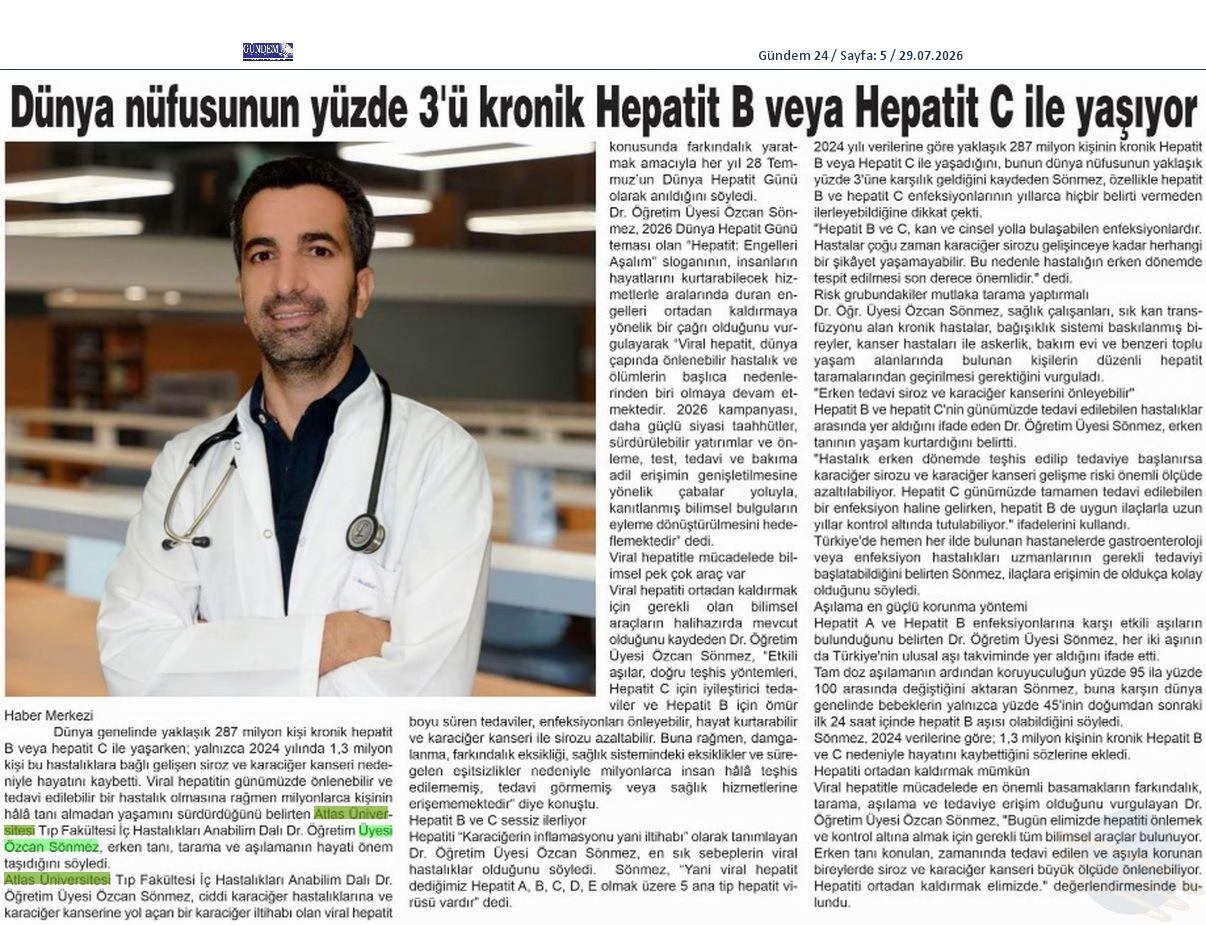

Dr. Özcan Sönmez, Assistant Professor at the Department of Internal Medicine, Faculty of Medicine, Atlas University, stated that although viral hepatitis is a preventable and treatable disease today, millions of people still live without being diagnosed, and emphasized that early diagnosis, screening, and vaccination are vital.
Dr. Özcan Sönmez, Assistant Professor at the Department of Internal Medicine, Faculty of Medicine, Atlas University, stated that July 28th is commemorated annually as World Hepatitis Day to raise awareness about viral hepatitis, an inflammation of the liver that can lead to serious liver diseases and liver cancer.
The theme for World Hepatitis Day 2026 is: 'Hepatitis: Let's Overcome the Barriers'
Dr. Özcan Sönmez, Assistant Professor, made the following assessment:
“The theme for World Hepatitis Day 2026, ‘Hepatitis: Breaking Down Barriers,’ is a call to remove the barriers that stand between people and services that can save lives. Viral hepatitis remains a leading cause of preventable disease and death worldwide. The 2026 campaign aims to translate proven scientific findings into action through stronger political commitments, sustainable investments, and efforts to expand equitable access to prevention, testing, treatment, and care.”
There are many scientific tools available to combat viral hepatitis.
The scientific tools needed to eradicate viral hepatitis are already available: effective vaccines, accurate diagnostic methods, curative treatments for Hepatitis C, and lifelong treatments for Hepatitis B can prevent infections, save lives, and reduce liver cancer and cirrhosis.
Despite this, millions of people remain undiagnosed, untreated, or without access to healthcare due to stigma, lack of awareness, deficiencies in the health system, and ongoing inequalities.
Hepatitis B and C progress silently.
Hepatitis can be defined as inflammation of the liver, and the most common causes are viral diseases. Specifically, there are five main types of hepatitis viruses: Hepatitis A, B, C, D, and E.
According to 2024 data, approximately 287 million people live with chronic Hepatitis B or Hepatitis C. This number corresponds to about 3 percent of the world's population. Hepatitis B and Hepatitis C infections, in particular, can progress for years without showing any symptoms.
Hepatitis B and C are infections that can be transmitted through blood and sexual contact. Patients often may not experience any symptoms until liver cirrhosis develops. Therefore, early detection of the disease is extremely important.
Those in the risk group should definitely get screened.
Dr. Özcan Sönmez, Assistant Professor, emphasized that healthcare workers, chronic patients who frequently receive blood transfusions, individuals with suppressed immune systems, cancer patients, and those in military barracks, nursing homes, and similar communal living environments should undergo regular hepatitis screenings.
"Early treatment can prevent cirrhosis and liver cancer."
Dr. Sönmez, Assistant Professor, stated that Hepatitis B and Hepatitis C are among the treatable diseases today, and emphasized that early diagnosis saves lives, adding the following:
“If the disease is diagnosed and treated early, the risk of developing liver cirrhosis and liver cancer can be significantly reduced. While hepatitis C has become a completely curable infection today, hepatitis B can also be kept under control for many years with appropriate medication.”
In Türkiye, gastroenterology or infectious disease specialists can initiate necessary treatment at hospitals located in almost every province. Access to medications is also quite easy.
Vaccination is the strongest method of protection.
Effective vaccines are available against Hepatitis A and Hepatitis B infections. Both vaccines are included in Türkiye's national vaccination schedule.
Sönmez stated that the protection provided after a full dose of vaccination ranges from 95 to 100 percent, but added that globally, only 45 percent of babies receive the hepatitis B vaccine within the first 24 hours after birth.
Sönmez added that according to 2024 data, 1,3 million people died due to chronic Hepatitis B and C.
It is possible to eliminate hepatitis.
Emphasizing that awareness, screening, vaccination, and access to treatment are the most important steps in the fight against viral hepatitis, Assistant Professor Dr. Özcan Sönmez concluded his remarks as follows:
“Today, we have all the scientific tools necessary to prevent and control hepatitis. In individuals who are diagnosed early, treated promptly, and protected by vaccination, cirrhosis and liver cancer can be largely prevented. Eradicating hepatitis is within our reach.”