






Humans are evolutionarily predisposed to produce through social cooperation and face-to-face interaction around shared goals. Therefore, work is not merely a field for generating income; it is also a living space where psychological needs such as belonging, identity, social learning, and self-actualization are met.
Interaction with others plays a significant role in the functioning of human psychology.
Thinking, producing, and giving and receiving feedback together with others is not merely a preference of modern business life, but a natural extension of human capacity for collaboration and social learning. In other words, interacting with others is not just a "feel-good" detail, but plays a significant role in the functioning of human psychology.
In an office environment, social connections form naturally.
It is crucial to make the right distinction here: the problem is not remote work itself, but the assumption that social contact will occur spontaneously. In an office environment, social bonds often form spontaneously, without prior planning, within the natural flow of daily interactions. Daily conversations, shared breaks, facial expressions, body language, immediate feedback, and shared rhythms unconsciously generate trust, belonging, and learning.
The quality of social contact is weakening.
In a remote work arrangement, however, such spontaneous contacts do not occur automatically; they weaken unless consciously planned.
The main risk here is that even if communication channels are open, the quality of contact weakens. In the context of remote work, this can be experienced as constant online activity, incessant notifications, video meeting fatigue, and a feeling of "connection exists, but no physical contact."
It's not sustainable if it's not designed correctly...
Although communication may seem to have increased, the creation of deep connections and meaning may weaken. Therefore, keeping people confined to their homes, cafes, or alone in front of a screen for extended periods is not sustainable if not designed correctly.
However, this does not mean that remote work should inevitably be equated with loneliness, detachment, or psychological risks.
The critical difference lies in whether social contact is established spontaneously or through conscious design. This is precisely where the role of human resources practices and occupational and organizational psychologists becomes decisive.
Remote work is a matter of transformation…
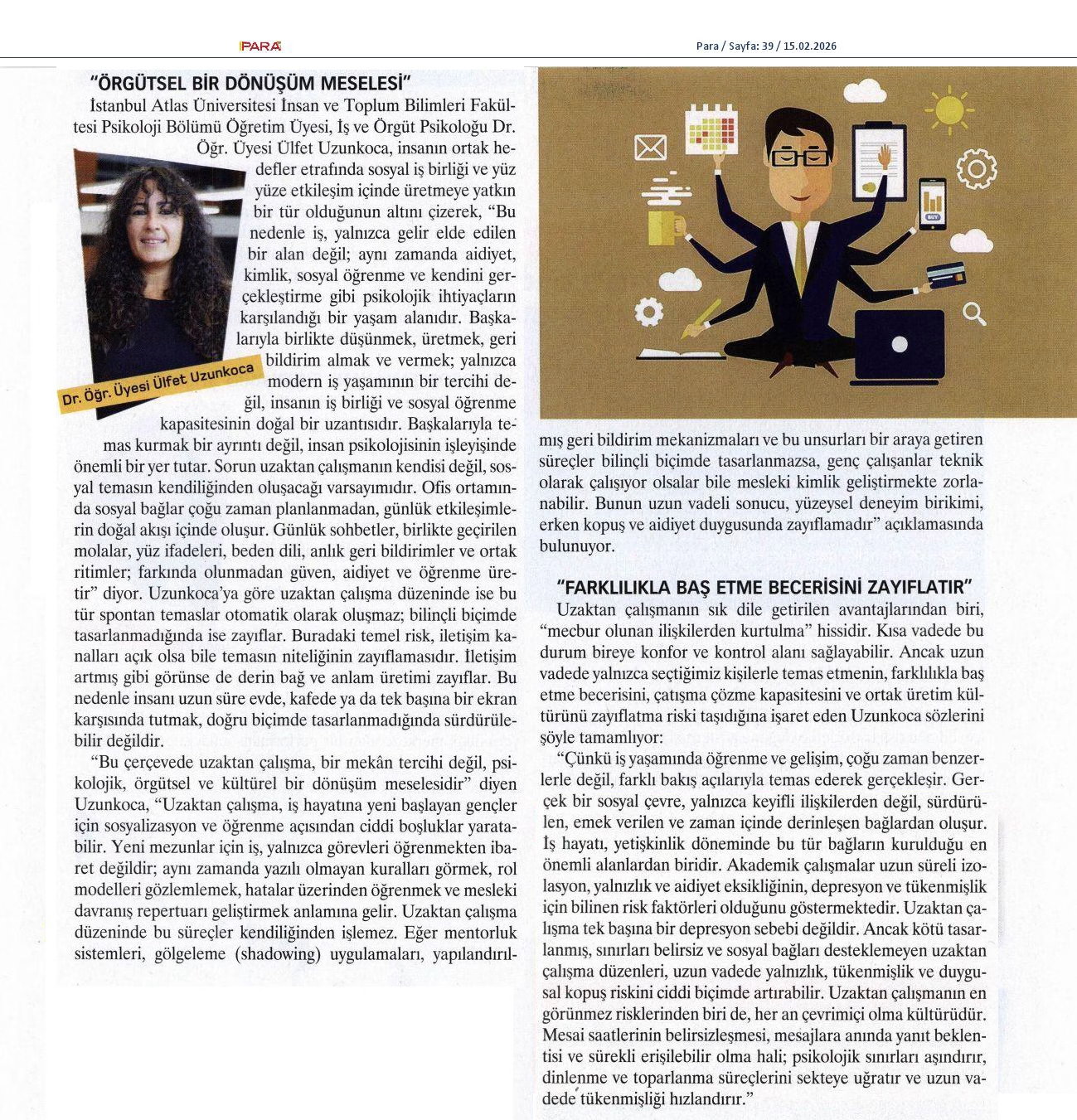
The sustainability of remote or hybrid work is possible not through technical solutions that ignore human social needs, but through holistic approaches that redesign social connections, learning processes, feedback mechanisms, and meaning-making. In this context, remote work is not a matter of "place preference," but rather a matter of psychological, organizational, and cultural transformation.