










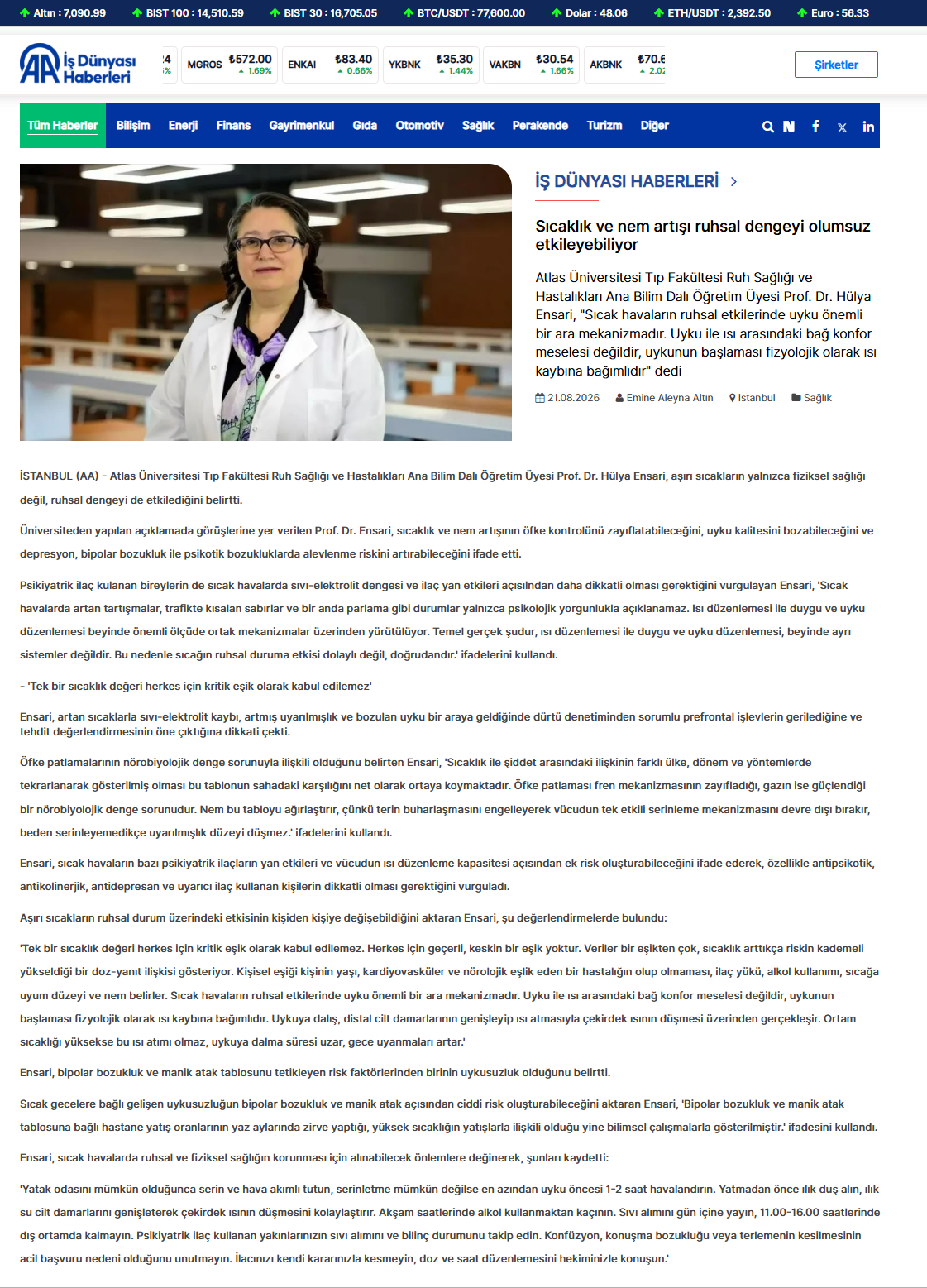


Professor Dr. Hülya Ensari, a faculty member at the Department of Mental Health and Diseases at Atlas University Faculty of Medicine, provided an assessment of the effects of increased heat and humidity during the summer months on mental health.
Ensari stated that increased arguments in hot weather, decreased patience in traffic, and "sudden outbursts of anger" cannot be explained solely by psychological fatigue, and pointed out that temperature regulation and emotion and sleep regulation are carried out through significantly common mechanisms in the brain.
Extreme heat can weaken anger management.
Prof. Dr. Hülya Ensari made the following assessments:
"The basic truth is this: thermoregulation and mood and sleep regulation are not separate systems in the brain. Therefore, the effect of heat on mental state is direct, not indirect.
The role of the hypothalamus: The body temperature set point is determined in the preoptic area of the hypothalamus. This area also plays a role in sleep regulation; that is, the preoptic area has been described as the "primary brain region that coordinates sleep with body temperature." Preoptic neurons, activated by central or peripheral heating, transmit temperature information to sub-centers that trigger autonomic responses. The main mediators the hypothalamus uses in carrying out this regulation are serotonin, dopamine, and norepinephrine; heat exposure disrupts these neurotransmitter systems.
Note the link between serotonin and impulse control.
Serotonergic system: The critical point is that the same neurotransmitter also plays a central role in impulse control. The relationship between impaired serotonergic function and impulsive-reactive aggression has been repeatedly demonstrated through CSF 5-HIAA levels, neuroendocrine stimulation studies, and tryptophan reduction paradigms. Increased thermoregulatory load associated with excessive heat can strain cognitive functions such as emotion regulation and impulse control, reducing a person's capacity to control stress and anger.
Temperature affects stress hormones and mood regulation.
The stress axis, cortisol, and inflammation: Excessive heat is a defined physiological stressor for the body. It activates the hypothalamus–pituitary–adrenal axis and triggers the inflammatory process; the released hormones and inflammatory markers impair attention, emotion, and cognition. Clinically, this manifests as a state of 'standby' where the person is prone to interpreting even neutral stimuli as threats.”
Unless the body cools down, the level of arousal doesn't decrease.
Prof. Dr. Hülya Ensari pointed out that as a result, when increasing temperatures combine with fluid and electrolyte loss, increased arousal, and disrupted sleep, the prefrontal functions responsible for impulse control decline, and threat assessment comes to the forefront.
“The fact that the relationship between heat and intensity has been repeatedly demonstrated in different countries, periods, and using different methods clearly reveals the practical application of this pattern. An outburst of anger is a neurobiological imbalance where the braking mechanism weakens and the fuel intensifies. Humidity exacerbates this situation because it prevents sweat evaporation, disabling the body's only effective cooling mechanism; as long as the body cannot cool down, the level of arousal does not decrease.”
People taking psychiatric medication should be more careful in hot weather.
Hot weather can pose an additional risk to the side effects of some psychiatric medications and the body's heat regulation capacity. Those taking antipsychotic, anticholinergic, antidepressant, and stimulant medications should be particularly cautious.
There is no single threshold for heat and humidity that applies to everyone.
The effect of extreme heat on mental health varies from person to person. No single temperature value can be considered a "critical threshold" for everyone. There is no universally applicable, sharp threshold. Data suggests a dose-response relationship where the risk gradually increases as the temperature rises, rather than a single threshold. The individual threshold is determined by age, the presence of cardiovascular and neurological conditions, medication load, alcohol consumption, heat tolerance level, and humidity.
Poor sleep quality can increase anger and stress the next day.
Sleep is a crucial intermediary mechanism in the psychological effects of hot weather. Rising nighttime temperatures, in particular, can make it harder to fall asleep and increase nighttime awakenings.
The link between sleep and temperature is not a matter of comfort; the initiation of sleep is physiologically dependent on heat loss. Falling asleep occurs through the dilation of distal skin vessels, releasing heat and causing a drop in core temperature. If the ambient temperature is high, this heat release does not occur; the time to fall asleep is prolonged, and nighttime awakenings increase. The coordination of heat and sleep regulation in the same hypothalamic region is the anatomical equivalent of this link, and high ambient temperatures disrupt sleep integrity, negatively affecting emotional processing, anger, and stress levels. It has also been shown that sleep disturbances impair mood regulation by increasing inflammatory markers and cortisol.”
Insomnia is a significant risk factor for manic episodes of bipolar disorder!
Professor Dr. Hülya Ensari emphasized that one of the most important risk factors triggering a manic episode in bipolar disorder is insomnia, stating, “Therefore, insomnia caused by hot nights is a direct and serious risk factor for a manic episode in bipolar disorder. Scientific studies have shown that hospitalization rates due to manic episodes in bipolar disorder peak during the summer months, and that high temperatures are associated with hospitalizations.”
Tips for Maintaining Mental Health in Hot Weather
Prof. Dr. Hülya Ensari offered the following suggestions for maintaining mental and physical health during hot weather:
- Keep the bedroom as cool and well-ventilated as possible; if cooling isn't possible, at least ventilate it 1-2 hours before bedtime.
- Take a warm shower before bed; warm water dilates blood vessels in the skin, helping to lower core body temperature.
- Avoid consuming alcohol in the evening.
- Spread your fluid intake throughout the day; avoid being outdoors between 11:00 and 16:00.
- Monitor the fluid intake and level of consciousness of your loved ones who are taking psychiatric medication; remember that confusion, speech difficulties, or cessation of sweating are reasons to seek immediate medical attention.
- Do not stop taking your medication on your own; discuss dosage and timing with your doctor.