













With the end of the general fishing ban in Türkiye's seas, the fishing season will reopen on September 1, 2026. Fish, expected to be more prevalent on dinner tables with the start of the fishing season, stands out as an important component of a healthy diet due to its high-quality protein, vitamins, minerals, and especially Omega-3 fatty acids.
Prof. Dr. M. Emel Alphan, Head of the Department of Nutrition and Dietetics at Atlas University Faculty of Health Sciences, also drew attention to the importance of fish consumption for all age groups.
Fish is a good source of protein.
Professor Dr. M. Emel Alphan's assessments are as follows:
“Fish meat contains approximately 18-20% protein. Its energy value varies depending on its fat content. Fish meat contains unsaturated fatty acids. Fish is also a good source of protein (18-20%). If the fish is lean, its energy is low; if it is fatty, its energy is high.”
Although lean fish contains 2,5% fat, the fat content in beef can rise to 18,5%, and this fat is saturated fat. Therefore, lean fish is recommended for those with cardiovascular disease.
Consuming marine-derived omega-3 is a necessity.
It is important to emphasize that consuming Omega-3 directly from marine sources is a necessity. The most essential forms of omega-3 obtained through diet are alpha-linolenic acid (ALA), eicosapentaenoic acid (EPA), and docosahexaenoic acid (DHA), which are abundant in cold-water fish (salmon, herring, sardines, mackerel, tuna).
Although ALA obtained from plant sources (flaxseed, walnuts, purslane, etc.) can be converted into EPA and DHA in the body, the rate of this conversion is physiologically insufficient; therefore, consuming omega-3s directly from marine sources is essential for a healthy diet.
Why are Omega-3 Fatty Acids Important?
Prof. Dr. M. Emel Alphan provided the following information regarding the critical and multifaceted roles of Omega-3 fatty acids in our health:
“One of the most prominent health benefits of fish is its Omega-3 polyunsaturated fatty acids, found especially in oily fish. Omega-3 fatty acids are essential nutrients that must be obtained through diet because the human body cannot synthesize them.”
Sea bass and sea bream; a source of Omega-3.
The fish richest in omega-3 fatty acids is the cod, which lives in the oceans.
In our country, sea bass and sea bream are the leading sources of Omega-3 in fish. Sardines and anchovies also contain Omega-3. Salmon and tuna, however, contain very little Omega-3. If needed, Omega-3 fatty acids can be obtained through fish oil capsules.
The Contributions of Omega-3 Fatty Acids Are Very Important
Highlighting the significant positive contributions of Omega-3 unsaturated fatty acids found in oily fish to health, Prof. Dr. M. Emel Alphan listed them as follows:
- Omega-3 fatty acids (EPA and DHA) are part of the structure of cell membranes. They exhibit anti-inflammatory, antioxidant, anti-adipogenic, and anti-arrhythmic effects in the body.
- It has an impact on growth and development. In infancy, it supports the development of brain cells and the retina. The brain has the highest fat content among the organs in the human body, and half of the brain's fat content consists of n-3 and n-6 essential fatty acids. During the fetal period (in the womb), they play the most critical role in the healthy development of the brain, central nervous system, and retina (eye) in infants and children. Regular fish consumption by the mother during pregnancy and breastfeeding protects the eye and neurological health of both the mother and the baby.
- It supports the maintenance of mental health in adults and positively affects cognitive performance. In older adults, it significantly reduces the risk of cognitive dysfunction, dementia, and Alzheimer's disease. It has positive effects in preventing concentration, memory, attention, and behavioral disorders. It also protects older individuals against age-related macular degeneration (vision loss).
Omega-3 is also important for heart health.
Prof. Dr. M. Emel Alphan pointed out that Omega-3 fatty acids make significant contributions to cardiovascular health and cancer prevention. Prof. Dr. M. Emel Alphan provided the following information:
“It lowers total cholesterol and bad cholesterol (LDL) while raising good cholesterol (HDL) levels. It also lowers triglyceride levels in the blood, improving the blood lipid profile.”
Thanks to its blood clotting-preventing (antithrombotic) and rhythm-disrupting (antiarrhythmic) effects, it offers protection against coronary artery blockages and heart attacks.
To protect against heart disease, it is recommended to consume at least 1-2 servings (150-300 g cooked) of fish per week. Reducing saturated fats and replacing them with these polyunsaturated fatty acids is the most effective clinical method for lowering cardiometabolic risk.
At least 1-2 portions of fish should be consumed per week.
To protect against heart disease and other illnesses, it is recommended to consume at least 1-2 servings (150-300 g cooked) of fish per week. Reducing saturated fats and replacing them with these polyunsaturated fatty acids is the most effective clinical method for lowering cardiometabolic risk.
It also contributes to bone health.
Fish contains omega-3 fatty acids, as well as vitamin D, phosphorus, and protein, all essential nutrients for bone health.
Professor Dr. Emel Alphan stated that fish contributes to calcium deposition in bones, adding, “Furthermore, thanks to its anti-inflammatory effect, it slows down the development of rheumatoid arthritis (joint inflammation) and provides protection against asthma. It has been determined that it plays a role in reducing the enzyme activity that causes joint inflammation and damages cartilage tissue. It is also effective in relieving joint sensitivity, reducing morning stiffness, and decreasing the need for medication in rheumatoid arthritis. In addition, Omega-3 fatty acids have positive effects in some inflammatory diseases such as ulcerative colitis.”
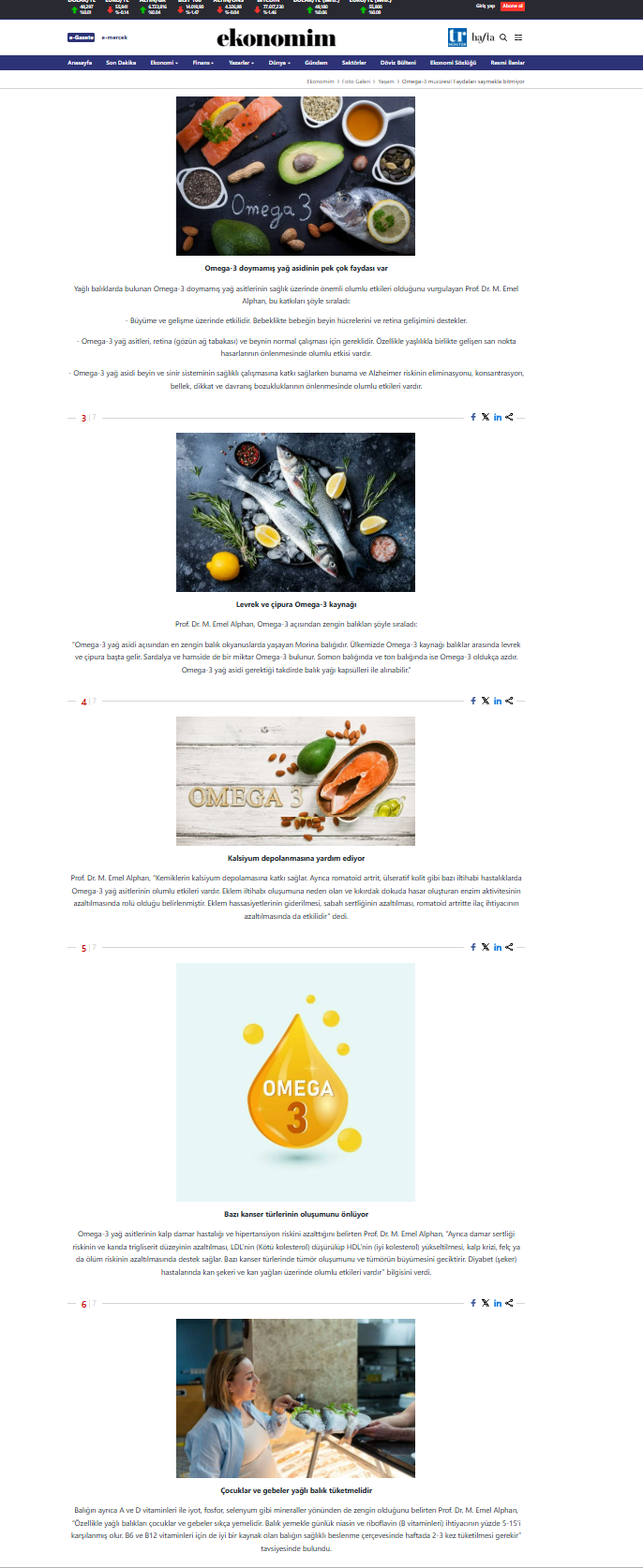
Children and pregnant women should consume oily fish.
Professor Dr. M. Emel Alphan stated that fish is also rich in vitamins A and D, as well as minerals such as iodine, phosphorus, and selenium, and advised, “Children and pregnant women should eat oily fish frequently. Eating fish provides 5-15% of the daily niacin and riboflavin (B vitamins) requirement. Fish, which is also a good source of vitamins B6 and B12, should be consumed 2-3 times a week as part of a healthy diet.”
Beware of mercury in fish consumption!
He concluded by stating that great care should be taken to minimize mercury exposure when consuming fish, which are a source of Omega-3 fatty acids, which are so important for health.
“To prevent methylmercury, dioxins, and heavy metals from harming the brain and nervous system development of infants, young children, and pregnant women, fish choices should be as follows: Anchovies, horse mackerel, bonito, mackerel, trout, salmon (farmed salmon), tuna, herring, and sea bass, which are high in EPA and DHA fatty acids, have the lowest mercury levels, and live near the surface, can be safely consumed. Swordfish, turbot, mussels, and similar shellfish, which live in deep waters and have a high risk of accumulating high amounts of mercury/heavy metals, should not be consumed.”