




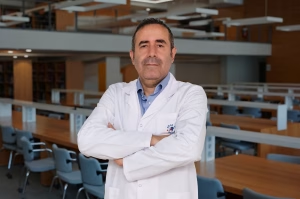




The whale, spotted off the coast of Samandağ around 4:00 PM on May 31, 2026, was recorded by Samet Uygur, owner of the Hatay Diving Center. Professor Dr. Cemal Turan, a faculty member in the Department of Molecular Biology and Genetics at Atlas University's Faculty of Engineering and Natural Sciences, who examined the footage, stated that preliminary assessments did not definitively determine the whale's species, but the morphological features in the images offered important clues.
Initial examinations of the whale's species suggest that it may be a sperm whale (cachalot) living in the Mediterranean Sea, with its tail structure and diving behavior strengthening this possibility.
Its tail structure and diving behavior attracted attention.
Prof. Dr. Turan stated that tail structure is one of the important criteria in species identification in whales, and that the images show the animal raising its tail completely above the water surface before diving.
Turan stated that the tail has a broad, triangular structure, noting that the distinctive indentations and protrusions seen in humpback whales were not discernible in the images, while the rear edge exhibited a smoother appearance.
Turan pointed out that diving behavior is also an important indicator, recalling that sperm whales characteristically raise their tails above the water surface before beginning deep dives, and stated that the individual in the images exhibited similar behavior.
The possibility of a sperm whale is emerging as more likely.
According to expert assessments, the individual in the images is more likely to be a sperm whale, a species regularly seen in the Mediterranean, than other species. Professor Dr. Turan stated that the current images are preliminary in nature, and that the view that the species is a sperm whale has also been confirmed by Professor Dr. Bayram Öztürk.
Its height is between 8 and 12 meters.
Based on assessments using the boat in the images as a reference, it was stated that the whale could be approximately 8 to 12 meters long. Turan emphasized that this size indicates an individual much larger than a newborn calf, suggesting that the animal could be young (juvenile) or approaching adulthood.
Turan, noting that newborn sperm whale calves are approximately 4 meters long, stated that the observed individual was a whale that had largely completed its development.
The region's bioproductivity could be influential.
Turan stated that the Samandağ coast has ecologically remarkable characteristics, adding that the nutrients carried by the Asi River to the Mediterranean Sea increase biological productivity in the region.
Turan stated that this situation supports the food chain, ranging from plankton to small pelagic fish, and suggested that the whale may have approached the area to benefit from these rich food sources.
Marine Mammals Project for Iskenderun Bay
Professor Dr. Turan emphasized that every whale sighting conducted along the Turkish coast is of great scientific importance, and highlighted that records of whales stranded or found alive in the Gulf of Iskenderun in previous years are also taken into consideration.
Turan stated that they have developed projects in collaboration with Atlas University and the Turkish Marine Research Foundation to monitor and protect marine mammals in the Gulf of Iskenderun, adding that the observations in the region provide important data for scientific studies.