











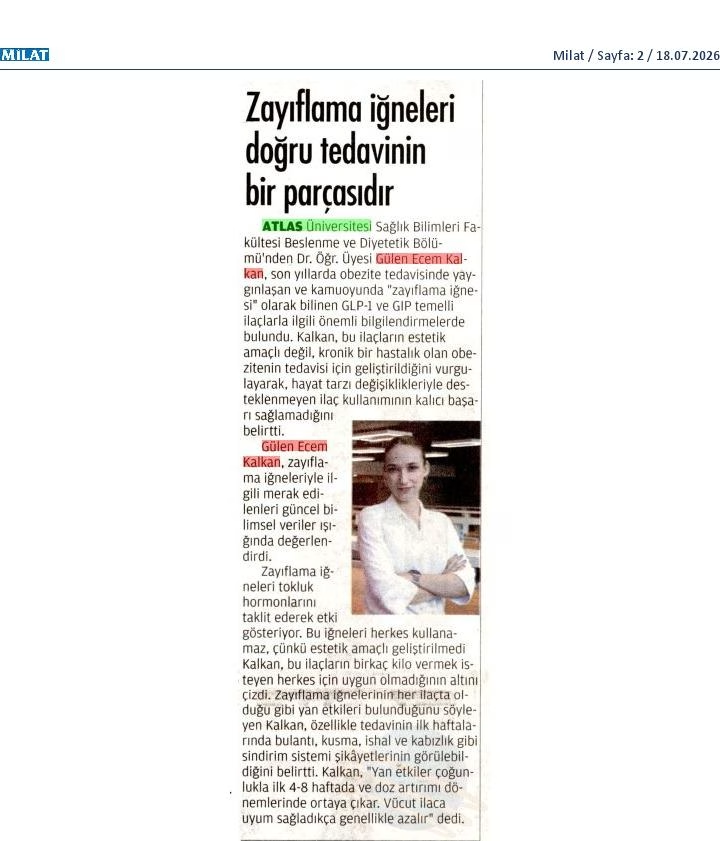

While obesity treatment has undergone a significant transformation in recent years, medications known in the public as "weight loss injections" are among the most discussed health topics. However, this intense interest also brings with it misinformation and unrealistic expectations.
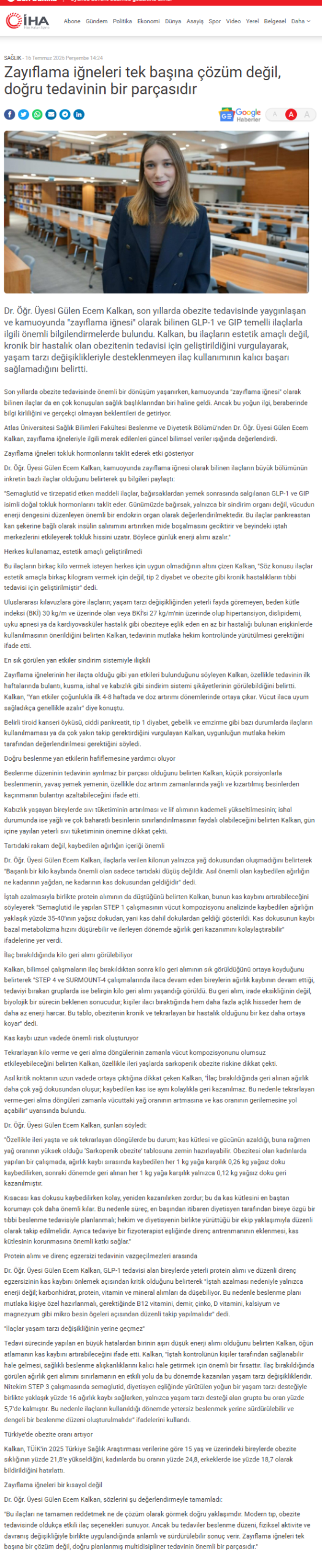
Dr. Gülen Ecem Kalkan, Assistant Professor at the Department of Nutrition and Dietetics, Faculty of Health Sciences, Atlas University, made important statements evaluating current scientific data regarding GLP-1 and GIP-based drugs.
"Weight loss injections work by mimicking satiety hormones."
Dr. Gülen Ecem Kalkan, Assistant Professor, stated that most of the medications known in the public as "weight loss injections" are incretin-based drugs, and provided the following information:
“Medications containing the active ingredients semaglutide and thizzpatide mimic the natural satiety hormones GLP-1 and GIP, which are secreted from the intestines after meals. Today, the intestine is considered not only a digestive organ but also an important endocrine organ that regulates the body's energy balance. These drugs increase insulin secretion from the pancreas in response to blood sugar levels, while delaying gastric emptying and affecting the appetite centers in the brain, thus prolonging the feeling of fullness. In this way, daily energy intake is reduced.”
"Not everyone can use it, it wasn't developed for aesthetic purposes."
Emphasizing that these medications are not suitable for everyone, Kalkan stated the following:
“These drugs were developed not for aesthetic purposes such as losing a few pounds, but for the medical treatment of chronic diseases such as type 2 diabetes and obesity.”
According to international guidelines, the use of these medications is recommended in adults who do not benefit sufficiently from lifestyle changes, have a body mass index (BMI) of 30 kg/m² or higher, or have a BMI of 27 kg/m² or higher with at least one comorbidity such as hypertension, dyslipidemia, sleep apnea, or cardiovascular disease. Kalkan stated that the treatment must be carried out under the supervision of a physician.
The most common side effects are related to the digestive system.
Kalkan stated that weight loss injections, like all medications, have side effects, and that digestive system complaints such as nausea, vomiting, diarrhea, and constipation can occur, especially in the first weeks of treatment.
“Side effects mostly occur in the first 4-8 weeks and during dose escalation periods. They generally decrease as the body adapts to the medication.”
Kalkan also noted that the medication should not be used or requires very close monitoring in certain situations, such as a history of thyroid cancer, severe pancreatitis, type 1 diabetes, pregnancy, and breastfeeding, emphasizing that suitability must be evaluated by a physician.
Proper nutrition helps alleviate side effects.
Kalkan stated that diet is an integral part of the treatment, adding that eating small portions, eating slowly, and avoiding fatty and fried foods, especially during dose increases, can reduce nausea.
Kalkan stated that increasing fluid intake and gradually increasing fiber intake can be beneficial for individuals experiencing constipation, while limiting fatty and very spicy foods can be helpful in cases of diarrhea. She also emphasized the importance of adequate fluid intake spread throughout the day.
"It's not the number on the scale that matters."
Kalkan stated that one should not focus solely on changes on the scale when it comes to weight loss, and made the following assessment:
“In successful weight loss, it’s not just the decrease on the scale that matters. What’s truly important is how much of the weight lost comes from fat and how much comes from muscle tissue.”
Kalkan stated that protein intake decreases along with decreased appetite, and that this can increase muscle loss, continuing as follows:
“Analysis of body composition in the STEP 1 study with semaglutide showed that approximately 35-40% of the weight lost came from lean tissue, including muscle. Loss of muscle tissue can lower basal metabolic rate and facilitate weight regain in the future.”
"Weight regain can be observed when medication is discontinued."
Kalkan stated that scientific studies have shown that weight regain is common after discontinuing medication, and added the following:
“In the STEP 4 and SURMOUNT-4 studies, it was observed that individuals who continued medication maintained weight loss, while those who discontinued treatment experienced significant weight regain. This regain is not a result of a lack of willpower, but rather an expected outcome of a biological process; when individuals stop the medication, they feel hungrier and expend less energy. This picture once again reveals that obesity is a chronic and recurring disease.”
"Muscle tissue is easy to lose, but difficult to regain."
Kalkan stated that recurring cycles of weight loss and regain can negatively affect body composition in the long term, and drew attention to the risk of sarcopenic obesity, especially in older adults.
Kalkan made the following assessment:
“In short, muscle tissue is easy to lose but difficult to regain; this makes preserving muscle mass from the outset much more important. Therefore, the process should be planned from the beginning with an individualized medical nutritional therapy by a dietitian; and it should be regularly monitored with a team approach carried out jointly by a physician and a dietitian. In addition, adding resistance training with a physiotherapist to the treatment significantly contributes to the preservation of muscle mass.”
Protein and resistance training are essential components of the treatment.
Kalkan stated that adequate protein intake and regular resistance exercise are critical for preventing muscle loss in individuals receiving GLP-1 treatment, adding that due to decreased appetite, not only energy but also carbohydrate, protein, vitamin, and mineral intake can decrease.
Therefore, emphasizing that nutrition plans should be tailored to the individual, Kalkan stated that regular monitoring for micronutrients such as vitamin B12, iron, zinc, vitamin D, calcium, and magnesium is important when necessary.
Medications are not a substitute for lifestyle changes.
Kalkan stated that one of the biggest mistakes made during the treatment process is excessively low energy intake, and made the following assessment:
“Making appetite control accessible to individuals is a significant opportunity to establish lasting healthy eating habits. The most effective way to limit weight regain seen when medication is discontinued is through lifestyle changes made during this period. Indeed, in the STEP 3 study, semaglutide, combined with intensive lifestyle support led by a dietitian, resulted in approximately 16% weight loss, while this rate remained at 5,7% in the group receiving only lifestyle support. Therefore, instead of malnutrition during the period of medication use, a sustainable and balanced diet should be established.”
Obesity rates are increasing in Türkiye.
Kalkan reminded that according to the Turkish Statistical Institute's 2025 Turkey Health Survey data, the prevalence of obesity among individuals aged 15 and over has risen to 21,8 percent, with this rate reported as 24,8 percent for women and 18,7 percent for men.
Weight loss injections are not a solution on their own.
Evaluating her statements, Assistant Professor Dr. Gülen Ecem Kalkan concluded her remarks with the following words:
“Neither completely rejecting these medications nor viewing them as miracle cures is the right approach. Modern medicine offers highly effective drug options for treating obesity. However, these treatments yield meaningful and sustainable results only when combined with dietary changes, physical activity, and behavioral modifications. Weight loss injections are not a solution on their own; they are an important part of a properly planned, multidisciplinary treatment.”