









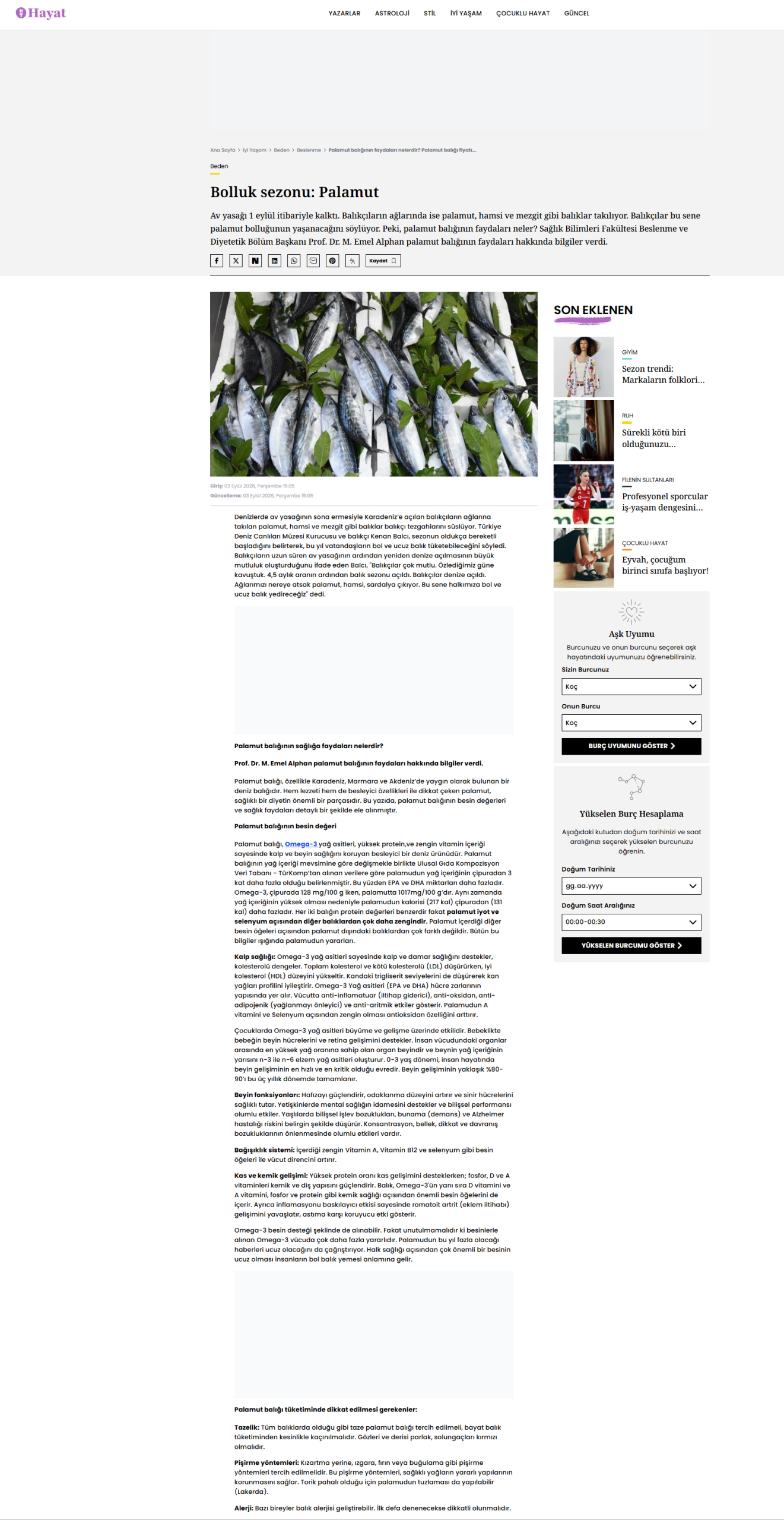

The fishing ban was lifted on September 1st. Fishermen are now catching fish like bonito, anchovy, and whiting in their nets. Fishermen say there will be an abundance of bonito this year. So, what are the benefits of bonito fish?
Prof. Dr. M. Emel Alphan, Head of the Department of Nutrition and Dietetics at Atlas University Faculty of Health Sciences, provided information about the benefits of bonito fish.
With the end of the fishing ban in the seas, fish such as bonito, anchovy, and whiting caught by fishermen who set sail into the Black Sea are adorning the fish stalls. Kenan Balcı, founder of the Turkish Marine Life Museum and a fisherman, stated that the season has started very bountifully, and that citizens will be able to consume plenty of cheap fish this year. Expressing his great happiness that fishermen have returned to sea after a long fishing ban, Balcı said, “The fishermen are very happy. We have reached the day we longed for. After a 4,5-month break, the fishing season has opened. Fishermen have gone out to sea. Wherever we cast our nets, we are catching bonito, anchovy, and sardine. This year we will provide our people with plenty of cheap fish.”
What are the health benefits of bonito fish?
Prof. Dr. M. Emel Alphan provided information about the benefits of bonito fish.
Bonito is a marine fish commonly found in the Black Sea, Marmara Sea, and Mediterranean Sea. Known for both its delicious taste and nutritional value, bonito is an important part of a healthy diet. This article details the nutritional value and health benefits of bonito.
Nutritional value of bonito fish
Bonito fish, Omega-3 Bonito is a nutritious seafood that protects heart and brain health thanks to its high fatty acid, protein, and vitamin content. While the fat content of bonito varies depending on the season, data from the National Food Composition Database – TürKomp shows that bonito has three times more fat than sea bream. Therefore, it has higher amounts of EPA and DHA. Omega-3 is 1017 mg/100 g in bonito, compared to 128 mg/100 g in sea bream. Also, due to its higher fat content, bonito has more calories (217 kcal) than sea bream (131 kcal). Both fish have similar protein values, however... Bonito is much richer in iodine and selenium than other fish. In terms of its other nutritional content, bonito is not very different from other fish. In light of all this information, here are the benefits of bonito.
Heart health: Thanks to its omega-3 fatty acids, it supports cardiovascular health and balances cholesterol. It lowers total cholesterol and bad cholesterol (LDL) while raising good cholesterol (HDL) levels. It also improves the blood lipid profile by lowering triglyceride levels in the blood. Omega-3 fatty acids (EPA and DHA) are part of the structure of cell membranes. In the body, they exhibit anti-inflammatory, antioxidant, anti-adipogenic, and anti-arrhythmic effects. The fact that bonito is rich in vitamin A and selenium increases its antioxidant properties.
Omega-3 fatty acids are effective in growth and development in children. In infancy, they support the development of brain cells and the retina. The brain has the highest fat content among the organs in the human body, and half of the brain's fat content consists of n-3 and n-6 essential fatty acids. The 0-3 year period is the stage in human life where brain development is fastest and most critical. Approximately 80-90% of brain development is completed during this three-year period.
Brain functions: It strengthens memory, increases concentration, and keeps nerve cells healthy. It supports the maintenance of mental health in adults and positively affects cognitive performance. In older adults, it significantly reduces the risk of cognitive dysfunction, dementia, and Alzheimer's disease. It has positive effects in preventing concentration, memory, attention, and behavioral disorders.
Immune system: It boosts the body's immunity with its rich content of nutrients such as Vitamin A, Vitamin B12, and selenium.
Muscle and bone development: The high protein content supports muscle development, while phosphorus, vitamins D and A strengthen bone and tooth structure. Fish contains Omega-3 fatty acids, as well as vitamins D and A, phosphorus, and protein, all essential for bone health. Furthermore, its anti-inflammatory effect slows the development of rheumatoid arthritis (joint inflammation) and offers protection against asthma.
Omega-3 can also be taken as a dietary supplement. However, it should be remembered that Omega-3 obtained from food is much more beneficial to the body. News that there will be an abundance of bonito this year suggests that it will be cheap. For public health, the fact that such an important food is inexpensive means that people will eat plenty of fish.
Things to consider when consuming bonito fish:
Freshness: As with all fish, fresh bonito should be preferred, and consumption of stale fish should be strictly avoided. Its eyes and skin should be bright, and its gills should be red.
Cooking methods: Instead of frying, grilling, baking, or steaming should be preferred. These cooking methods help preserve the beneficial properties of healthy fats. Since bonito is expensive, salting (lakerda) can also be done with mackerel.
Allergy: Some individuals may develop a fish allergy. Caution should be exercised if trying it for the first time.