










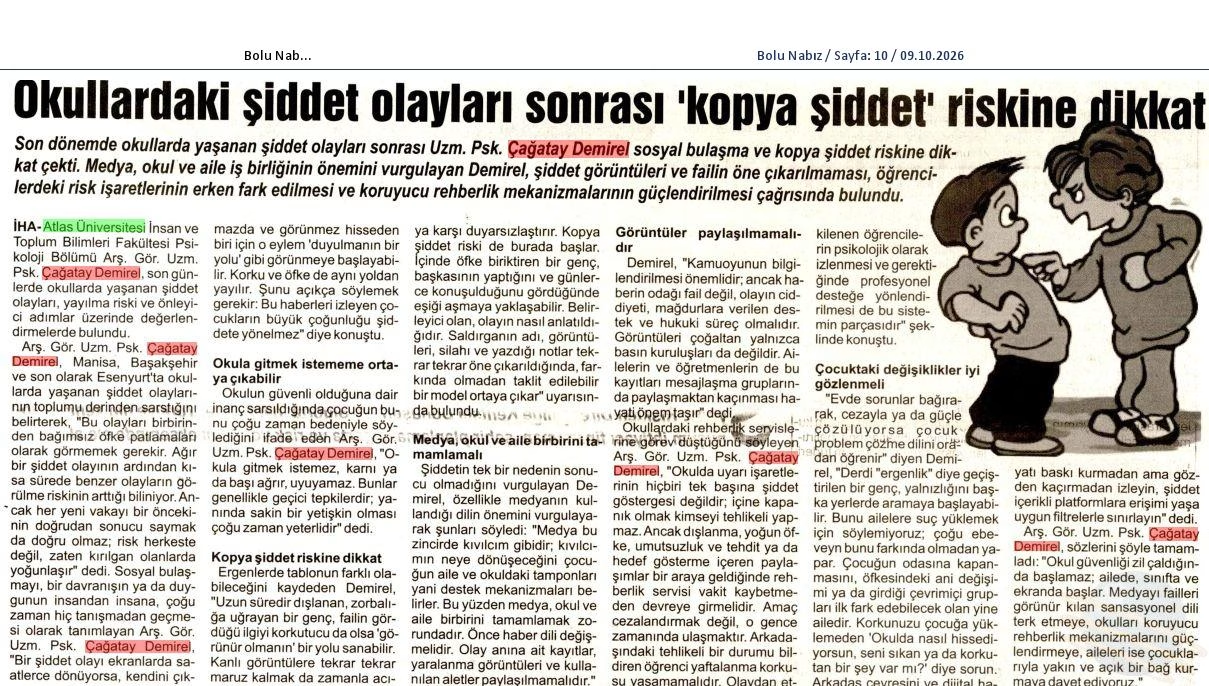
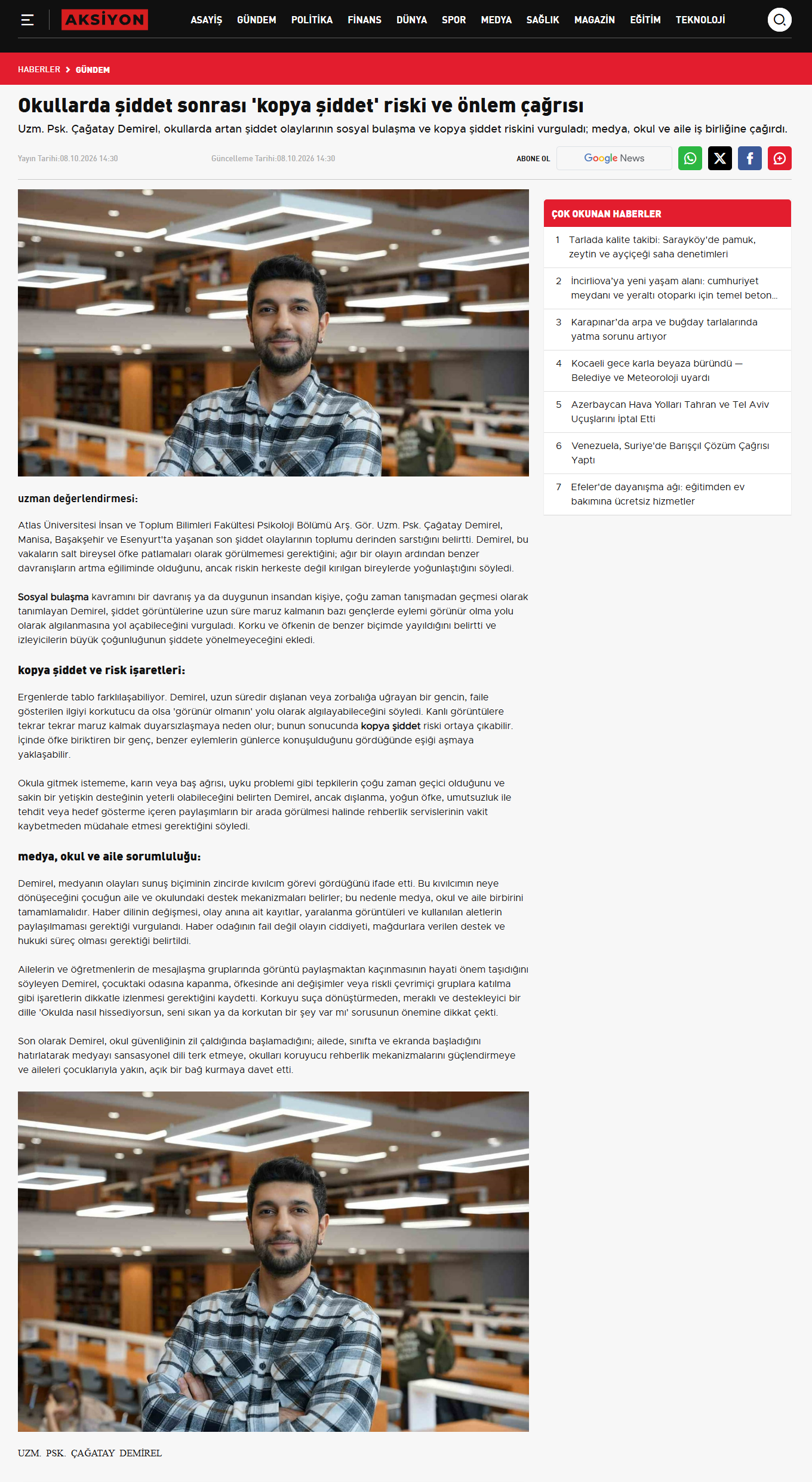
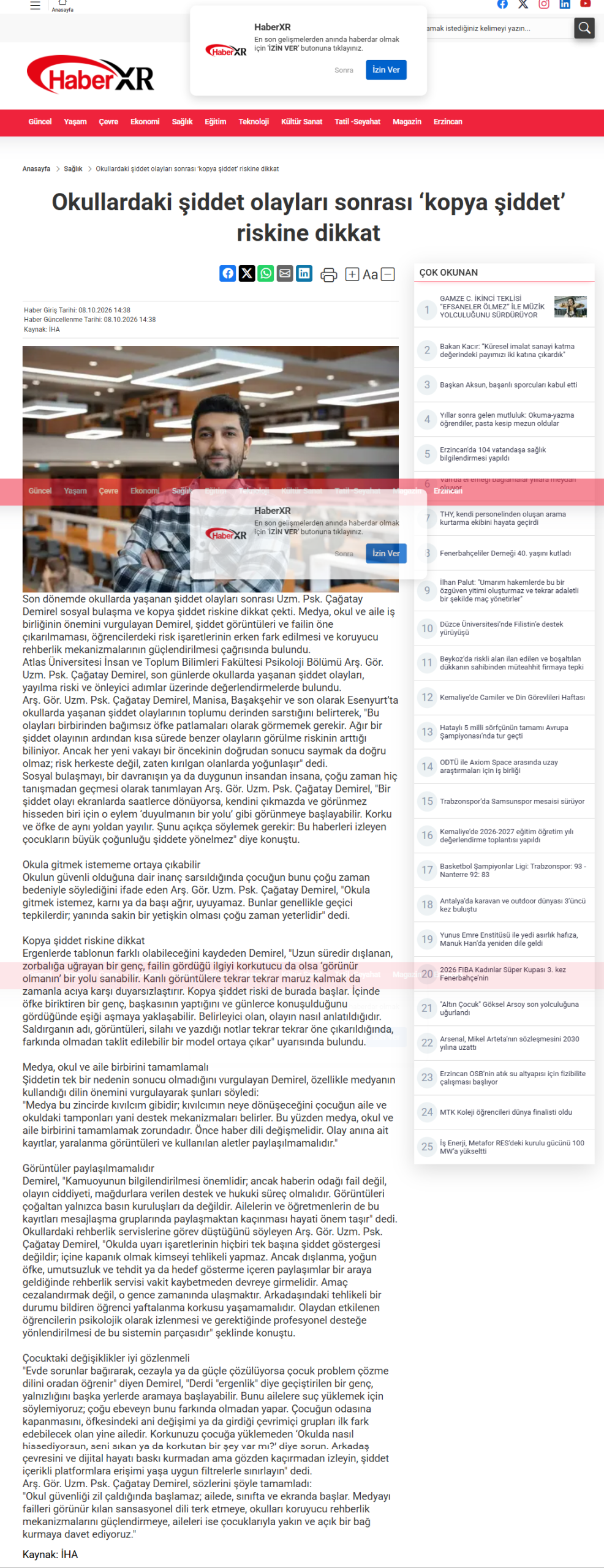
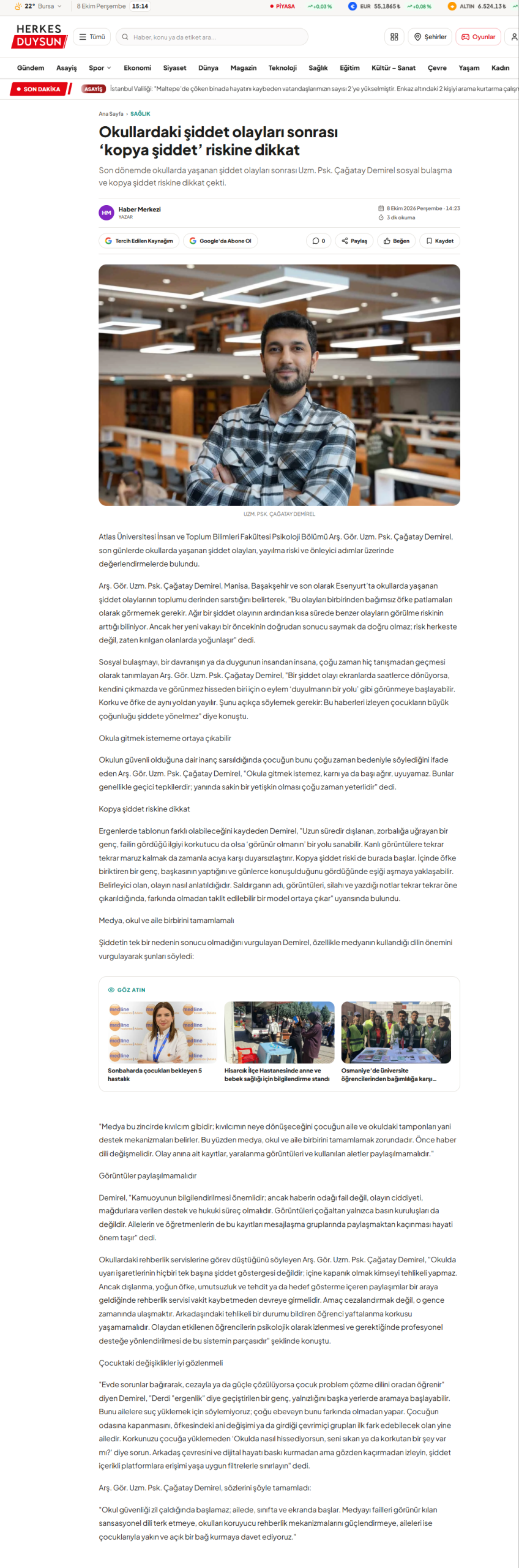
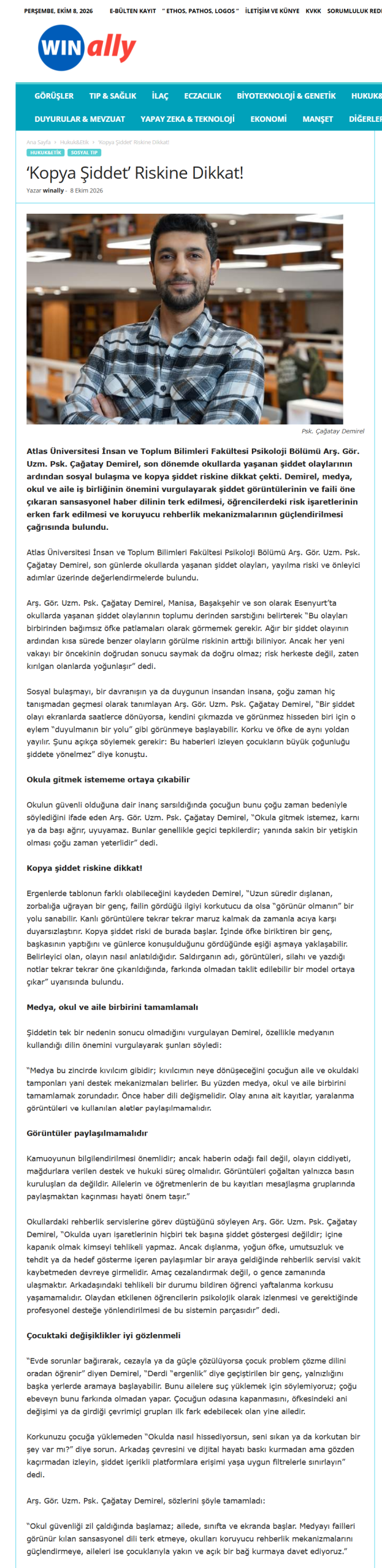
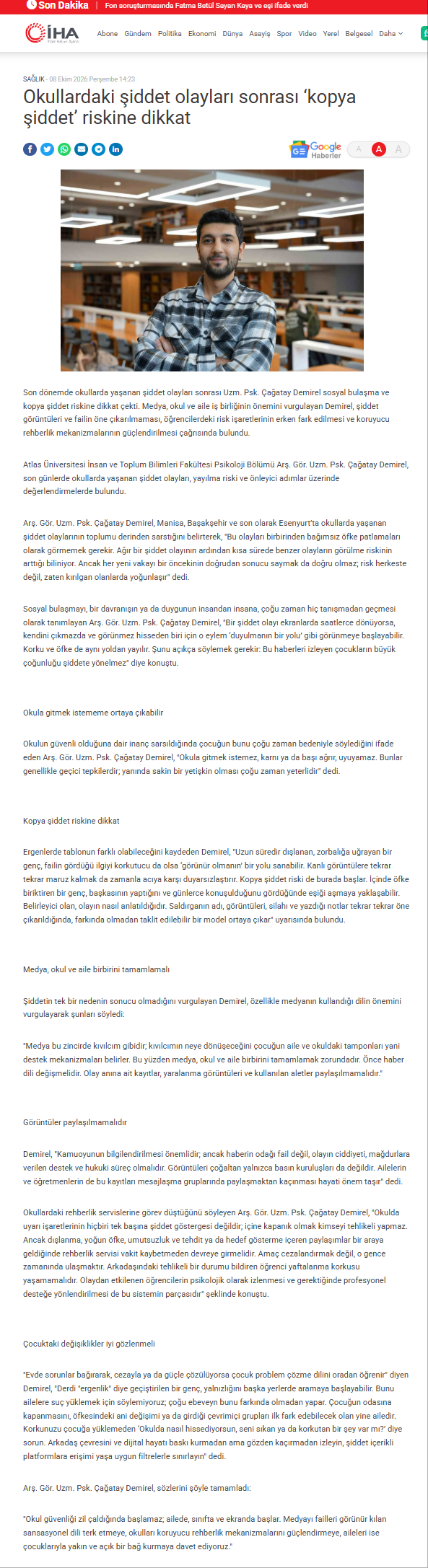





Atlas University Faculty of Human and Social Sciences, Department of Psychology, Research Assistant and Specialist Psychologist Çağatay Demirel, made assessments on the recent incidents of violence in schools, the risk of its spread, and preventive measures.
These shouldn't be seen as separate outbursts of anger.
Research Assistant and Specialist Psychologist Çağatay Demirel stated the following:
“The violent incidents in schools in Manisa, Başakşehir, and most recently Esenyurt have deeply shaken society. These events should not be seen as isolated outbursts of anger. It is known that the risk of similar incidents increases shortly after a serious act of violence. However, it would also be incorrect to consider each new case as a direct consequence of the previous one; the risk is not concentrated in everyone, but rather in those who are already vulnerable.”
The vast majority of children who watch these news reports do not turn to violence.
Social contagion is the transmission of a behavior or emotion from person to person, often without ever meeting them. If a violent event is shown on screens for hours, it may begin to seem like "a way to be heard" to someone who feels trapped and invisible. Fear and anger spread in the same way. It must be stated clearly: the vast majority of children who watch these news reports will not turn to violence.
A reluctance to go to school may emerge.
Research Assistant and Specialist Psychologist Çağatay Demirel stated that when a child's belief in the safety of school is shaken, the child often expresses this through their body language, saying, "They may not want to go to school, they may have stomach or headaches, or they may not be able to sleep. These are usually temporary reactions; having a calm adult present is often enough."
Beware of the Risk of Violence from Copying!
Demirel noted that the situation might be different in adolescents, and continued as follows:
“A young person who has long been ostracized and bullied may perceive the attention the perpetrator receives, however frightening, as a way to ‘become visible.’ Repeated exposure to graphic images also desensitizes the victim to pain over time. This is where the risk of copycat violence begins. A young person who has been harboring anger may come close to crossing the threshold when they see someone else doing it and it being talked about for days. What is crucial is how the event is described. When the attacker’s name, images, weapon, and notes are repeatedly highlighted, an unconsciously imitable model emerges.”
Media, School, and Family Should Complement Each Other.
Violence is not the result of a single cause. The language used by the media is particularly important. The media is like a spark in this chain; what that spark will develop into is determined by the child's buffers, or support mechanisms, at home and at school. Therefore, the media, school, and family must complement each other. First, the language of news reporting must change. Footage of the incident, images of injuries, and the tools used should not be shared.
The images should not be shared anywhere.
Informing the public is important; however, the focus of the news should not be on the perpetrator, but on the seriousness of the incident, the support given to the victims, and the legal process. It is not only media outlets that are circulating these images. It is also vital that families and teachers refrain from sharing these recordings in messaging groups.”
Guidance services have a major role to play.
Research Assistant and Specialist Psychologist Çağatay Demirel, stating that guidance services in schools have a role to play, said the following:
“None of the warning signs at school are, by themselves, an indicator of violence; being withdrawn doesn't make anyone dangerous. However, when exclusion, intense anger, despair, and threatening or targeting posts come together, the guidance service must intervene without delay. The goal is not punishment, but to reach that young person in time. A student who reports a dangerous situation involving a friend should not have to live in fear of being stigmatized. Psychological monitoring of students affected by the incident and referral to professional support when necessary are also part of this system.”
Changes in the child should be carefully observed.
If problems at home are solved by shouting, punishment, or force, the child learns problem-solving language from there. A teenager whose problems are dismissed as "adolescence" may begin to seek solace elsewhere. We're not saying this to blame families; most parents do this unknowingly. It is the family that will often be the first to notice when a child withdraws into their room, when their anger changes suddenly, or when they join online groups.
Instead of projecting your fears onto the child, ask, "How do you feel at school? Is there anything that bothers or scares you?" Monitor their peer group and online life without being overly controlling, and restrict access to violent platforms with age-appropriate filters.
Research Assistant and Specialist Psychologist Çağatay Demirel concluded his remarks as follows:
“School safety doesn’t begin when the bell rings; it begins at home, in the classroom, and on screen. We call on the media to abandon the sensationalist language that makes perpetrators visible, on schools to strengthen protective guidance mechanisms, and on families to build close and open relationships with their children.”