











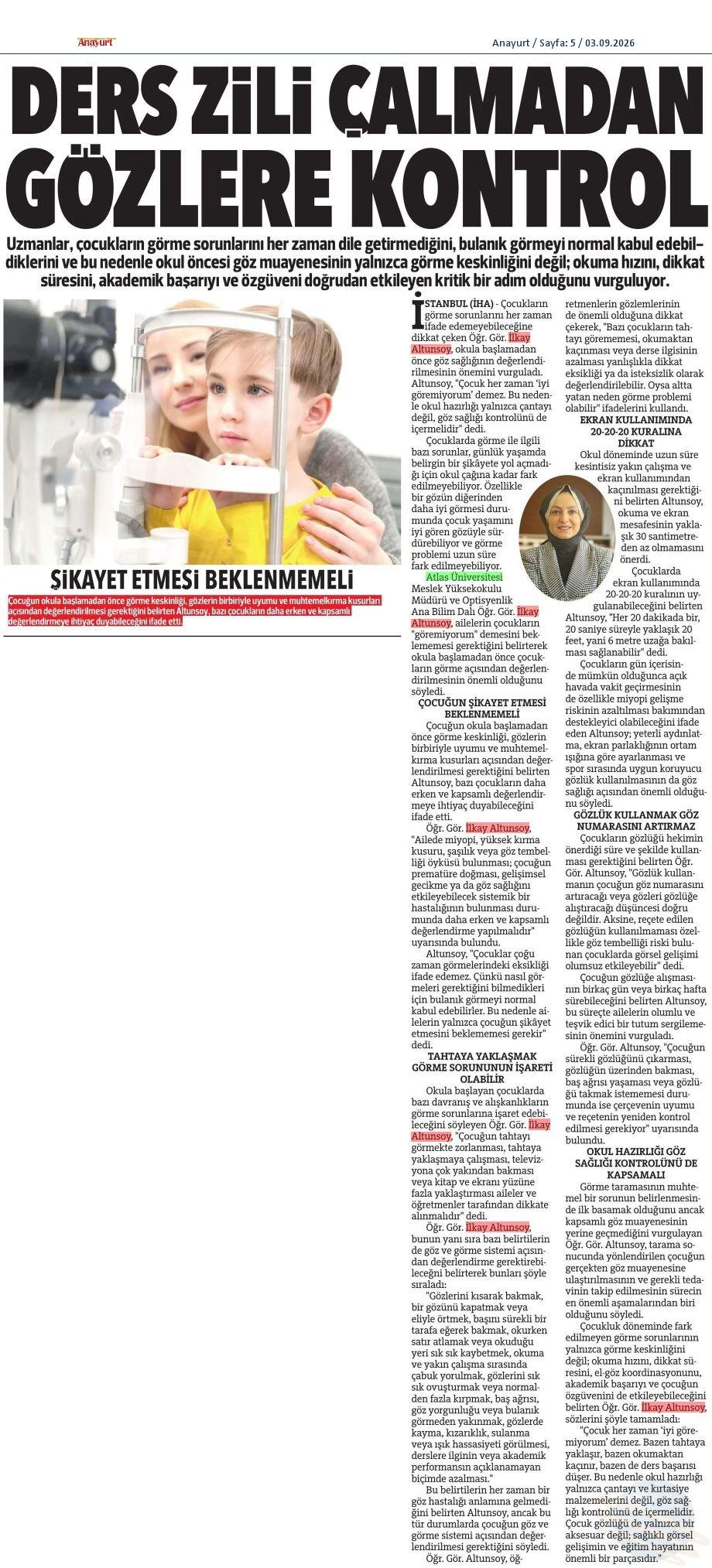
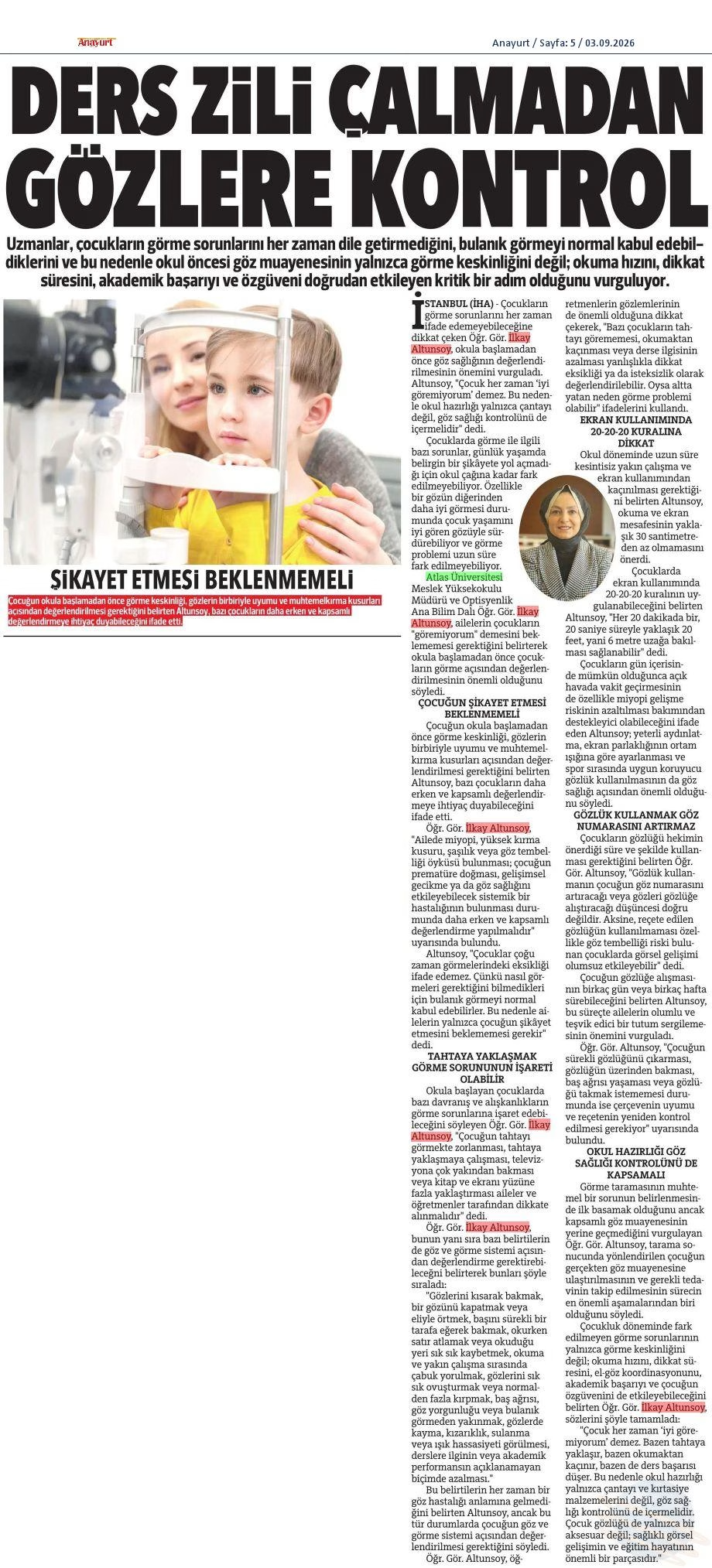
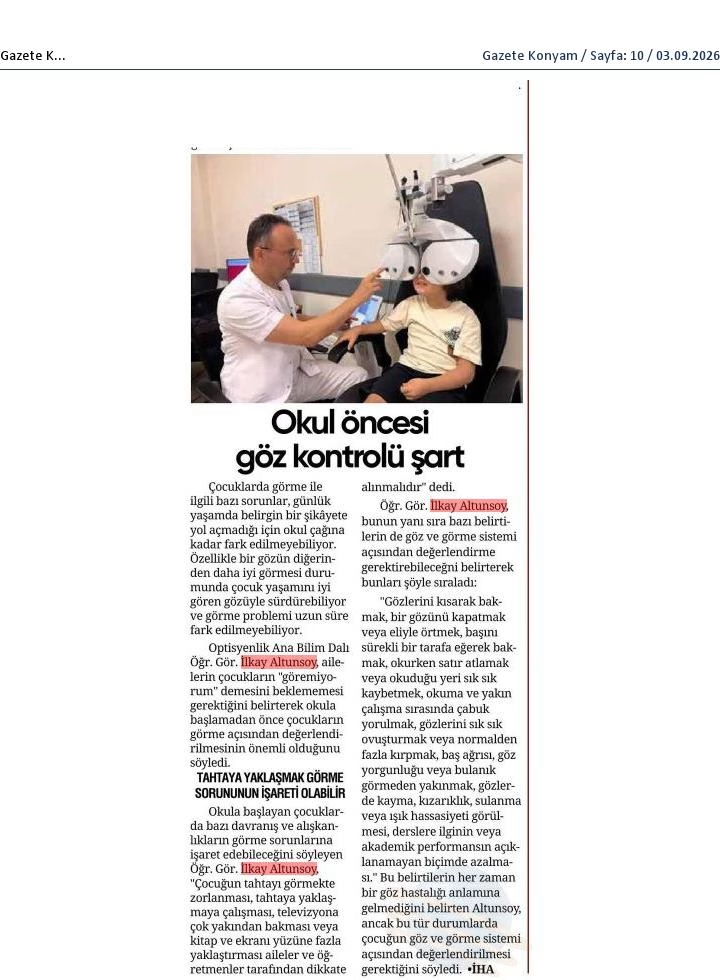

Some vision problems in children may go unnoticed until school age because they don't cause noticeable discomfort in daily life. Especially if one eye sees better than the other, the child may use the better-seeing eye for most of their life, and the vision problem may go unnoticed for a long time.
Ilkay Altunsoy, Director of Atlas University Vocational School and Lecturer in the Optometry Program, stated that families should not wait for their children to say "I can't see," emphasizing the importance of evaluating children's vision before they start school.
Why is an eye exam before starting school important?
Lecturer İlkay Altunsoy provided the following information:
“Before a child starts school, they should be assessed for visual acuity, eye coordination, and any potential refractive errors. Some children may need earlier and more comprehensive assessment.”
An earlier and more comprehensive evaluation is necessary if there is a family history of myopia, high refractive error, strabismus, or amblyopia; or if the child was born prematurely, has a developmental delay, or has a systemic disease that may affect eye health.
Children often cannot express their vision problems. Because they don't know how to see, they may accept blurred vision as normal. Therefore, families shouldn't just wait for the child to complain.”
Approaching the blackboard may be a sign of a vision problem.
Lecturer İlkay Altunsoy stated that some behaviors and habits in children starting school may indicate vision problems, adding, "A child having difficulty seeing the blackboard, trying to get closer to the blackboard, looking at the television from very close up, or holding books and screens too close to their face should be taken into consideration by families and teachers."
Lecturer İlkay Altunsoy also stated that some symptoms may require evaluation in terms of the eyes and visual system, and listed them as follows:
- Looking with narrowed eyes,
- To close one eye or cover it with one's hand,
- Looking by constantly tilting the head to one side,
- Skipping lines while reading or frequently losing one's place,
- Getting tired quickly while reading and doing close work,
- Rubbing your eyes frequently or blinking more than usual,
- Complaining of headaches, eye strain, or blurred vision,
- Symptoms include eye deviation, redness, watering, or light sensitivity.
- An unexplained decrease in interest in classes or academic performance.
These symptoms don't always indicate an eye disease, but in such cases, the child should be evaluated for their eyes and visual system.
Teachers' observations are very important.
Lecturer Altunsoy, emphasizing the importance of teachers' observations, stated, "Some children's inability to see the blackboard, avoidance of reading, or decreased interest in the lesson may be mistakenly interpreted as attention deficit or lack of motivation. However, the underlying cause may be a vision problem."
Pay attention to the 20-20-20 rule when using screens.
Altunsoy stated that prolonged, uninterrupted close work and screen use should be avoided during the school year, and recommended that the distance between reading and screens should not be less than approximately 30 centimeters.
“The 20-20-20 rule can be applied to screen use for children. Every 20 minutes, they should look approximately 20 feet, or 6 meters, away for 20 seconds.”
Spending as much time outdoors as possible during the day can also be helpful in reducing the risk of developing myopia. Adequate lighting, adjusting screen brightness according to ambient light, and using appropriate protective eyewear during sports are also extremely important for eye health.
Wearing glasses does not increase your eye prescription.
Lecturer Altunsoy, stating that children should use their glasses for the duration and in the manner recommended by the doctor, made the following assessments:
"The idea that wearing glasses will increase a child's refractive error or make their eyes accustomed to glasses is incorrect. On the contrary, not wearing prescribed glasses can negatively affect visual development, especially in children at risk of amblyopia (lazy eye)."
It may take a few days or a few weeks for a child to get used to glasses. During this process, it's important for families to maintain a positive and encouraging attitude. However, if the child constantly takes off their glasses, looks over them, experiences headaches, or doesn't want to wear them, the frame fit and prescription need to be rechecked.
School Preparation Should Also Include Eye Health Check-ups
Lecturer Altunsoy emphasized that vision screening is the first step in identifying a potential problem, but it does not replace a comprehensive eye examination. She stated that ensuring the child referred as a result of the screening actually undergoes an eye examination and that the necessary treatment is followed up is one of the most important stages of the process.
Vision problems can also affect academic performance.
Lecturer İlkay Altunsoy stated that vision problems that go unnoticed in childhood can affect not only visual acuity but also reading speed, attention span, hand-eye coordination, academic achievement, and self-confidence, and concluded her remarks as follows:
“A child doesn’t always say ‘I can’t see well.’ Sometimes they get closer to the blackboard, sometimes they avoid reading, and sometimes their academic performance suffers. Therefore, school preparation should include not only the bag and stationery, but also an eye health check. Children’s glasses are not just an accessory; they are an important part of healthy visual development and education.”